Planning to travel alone? New iVisa data shows that solo applicants are at far greater risk of visa denial.
MIAMI, April 09, 2026 (GLOBE NEWSWIRE) -- After reviewing more than 700,000 finalized visa decisions submitted between October 2024 and October 2025, iVisa analysts found that solo applicants face the highest rejection rates of all travelers.
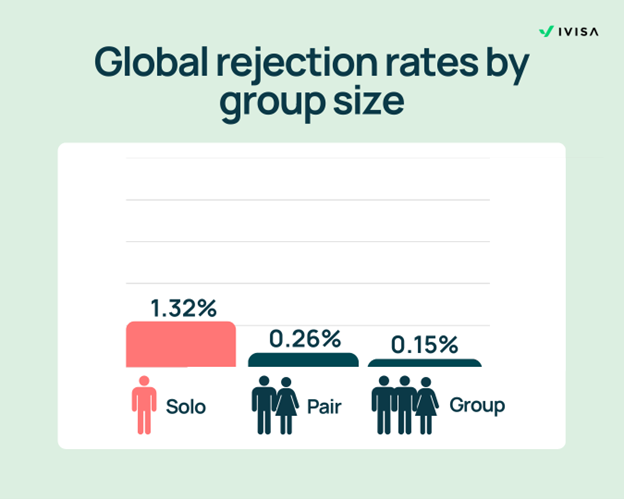
In fact, they are five times more likely to be rejected than applicants in pairs, and nearly nine times more likely than travelers applying in groups of three or more.
Key findings at a glance
• Solo travelers: 1.32% rejection rate
• Pairs: 0.26%
• Groups of 3 or more: 0.15%
• United Kingdom solos: 12 times higher rejection risk compared to pairs
• United States solos: 5 times higher rejection risk
• France and Italy: Solo travelers face 4 to 6 times the rejection rate of paired applicants
These differences were consistent across nationalities and visa types. The gap was most noticeable in the UK, with British solo travelers showcasing a rejection rate of 2.36%, compared to 0.20% for pairs and 0.10% for groups.
The pattern appears across multiple countries, including the United Kingdom, France, Italy, Germany, the Netherlands, and the United States.
Why solo travelers are more vulnerable
Traveling alone often means submitting fewer supporting documents, which can introduce uncertainty during the screening process. Visa officers assess applications quickly, and solo cases often provide less contextual evidence.
“Solo applications often lack supporting context, such as shared bookings or coordinated itineraries, that help demonstrate genuine travel intent,” said Luis Enrique Portal Gonzalez, iVisa’s Global visa application expert, while reviewing the data report. “Without that additional proof, applications are more likely to raise questions during review.”
Former US visa officer Christa Byker, noted in an interview with iVisa that when an application creates confusion, it is more likely to be refused rather than clarified, as officers are not incentivized to resolve uncertainty on behalf of the applicant. She warned that cases that require additional interpretation are often denied or redirected for further review through interviews.
By contrast, applications from pairs and groups tend to include stronger documentation, such as coordinated travel dates, shared hotel reservations, and multiple points of contact, which provide clearer evidence of intent and reduce uncertainty, making these applications easier to assess.
How solo travelers can reduce their rejection risk
Traveling alone is not inherently risky, but solo applicants should take care to provide enough details to avoid unnecessary rejection. iVisa recommends applying early and providing the following documents to clarify intent and demonstrate that the trip is well planned, with supporting documents such as accommodation details, return travel, and a clear itinerary
The broader trend
These findings on group size are part of iVisa’s larger 2025 Visa Rejection Report, which analyzes patterns in visa approvals and denials across age, gender, nationality, and travel type. Across the dataset, solo travel emerges as one of the strongest predictors of rejection.
A real-world case that illustrates this pattern is Carlos, a traveler from South Africa who was initially denied a UK visa when he applied on his own but was approved quickly when he applied a second time with two friends.
“The first time I applied alone, I was denied even though I felt prepared,” Carlos explained. “A few months later, two friends and I applied as a group for the same trip, and I organized all of our documents. We ensured that our itinerary, hotel bookings, and return flights aligned. This time, all three of us were approved with no issues.”
His experience directly reflects the broader pattern observed in the data: group applications tend to reduce ambiguity and provide clear evidence of travel intent, thereby increasing the likelihood of approval.
About iVisa
iVisa is a digital travel documentation platform that helps travelers easily secure visas, entry permits, and digital travel authorizations. By analyzing real-world approval trends across hundreds of thousands of government decisions, iVisa empowers travelers to plan smarter and reduce avoidable rejections.
Media contact:
Annkatrin Siegl
Brand Reputation Specialist, iVisa
annkatrin.siegl@ivisa.com
A photo accompanying this announcement is available at https://www.globenewswire.com/NewsRoom/AttachmentNg/8c785ceb-d70d-4f55-a49d-66c39f131a09