Most Business Transformations Fail. Here's What Leaders Can Do Differently
PR Newswire
BOSTON, May 19, 2026
- New Book Outlines Science-Based Principles for Making Organizational Change Stick
- Authors Identify "Change Distance" as a Hidden Barrier Between Executives and Employees
- Practical Roadmap Helps Leaders Close Adoption Gaps and Sustain Momentum
BOSTON, May 19, 2026 /PRNewswire/ -- Companies are investing trillions of dollars in transformation initiatives, yet change efforts continue to fail routinely. The financial costs are significant, but the human costs may be greater, leaving organizations with "scar tissue" that reduces their ability to adapt in the future. A new book, How Change Really Works, published today by Harvard Business Review Press, argues that most transformations fail not because of flawed strategy but because leaders misunderstand how people actually change.
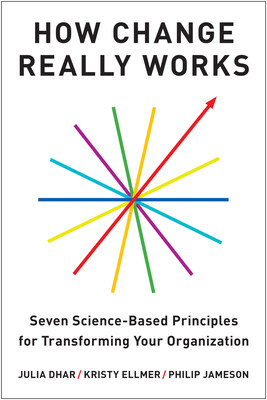
Written by Boston Consulting Group (BCG) experts Julia Dhar, Kristy R. Ellmer, and Philip Jameson, the book draws on behavioral science, executive interviews, and the authors' experience leading large-scale transformations. It introduces science-based principles and a roadmap to help leaders improve the odds of success.
"More than 70% of transformations fail to live up to their original goals," said Kristy R. Ellmer, a Managing Director and Partner at BCG. "But this is not inevitable. Change follows predictable human patterns. When leaders use behavioral science to work with those patterns rather than against them, success becomes far more achievable."
Seven Principles for Making Change Stick
The book outlines science-based principles that distinguish successful transformations from those that stall:
- Get true agreement, not false alignment. Executives must genuinely agree on why change is needed, what will change, and how it will happen. Without this foundation, the broader organization cannot move forward.
- Increase agency, not just involvement. Employees are more likely to adopt new behaviors when they have real influence – making decisions, influencing someone else's decisions, and being represented by trusted peers.
- Expect take-up to be earned, not automatic. In successful change programs, leaders are curious about situations where employees don't have the capability, opportunity, or motivation to make a change. Then they use the organization's resources to lower those barriers until none are left. They inspire, encourage, and enable.
- Understand emotions through feedback, not instinct. Successful organizations measure employee emotions, confidence, and capacity continuously. When concerning results appear, they take action. When they observe a behavior they would like to see more of, they encourage it.
- Use a process with rituals, not reactions. Structured meetings for reflection, debate, and celebration reduce decision fatigue and help teams protect cognitive capacity during complex change efforts.
- Share stories and symbols, not just dollars. Leaders understand their employees' goals and desires and use that knowledge to craft and tell a compelling, emotional story about their change and reinforce it through symbolic objects, actions, and events.
- Create momentum throughout, not just at the start. Leaders anticipate when progress may stall and adjust plans to sustain energy beyond early wins.
"Leaders often focus on strategy and targets," said Julia Dhar, Managing Director and Partner at BCG. "But change succeeds or fails in employees' daily experiences. Measuring emotions, removing barriers, and giving people real agency are operational necessities."
How Change Really Works provides a structured five-phase guide for putting these principles to work: Deciding to change, Planning for change, Starting change, Persisting with change, and Ending change. In an era defined by market volatility, AI, and geopolitical uncertainty, the authors argue that applying behavioral science to change is no longer optional, it is essential.
"Change doesn't fail because people resist," said Philip Jameson, Associate Director at BCG. "It fails because leaders misunderstand how people really change. But learning the behavioral science can give them a practical way forward."
Media Contact:
Bruce Wraight
wraight.bruce@bcg.com
About Boston Consulting Group
Boston Consulting Group partners with leaders in business and society to tackle their most important challenges and capture their greatest opportunities. BCG was the pioneer in business strategy when it was founded in 1963. Today, we work closely with clients to embrace a transformational approach aimed at benefiting all stakeholders—empowering organizations to grow, build sustainable competitive advantage, and drive positive societal impact.
Our diverse, global teams bring deep industry and functional expertise and a range of perspectives that question the status quo and spark change. BCG delivers solutions through leading-edge management consulting, technology and design, and corporate and digital ventures. We work in a uniquely collaborative model across the firm and throughout all levels of the client organization, fueled by the goal of helping our clients thrive and enabling them to make the world a better place.

 View original content to download multimedia:https://www.prnewswire.com/news-releases/most-business-transformations-fail-heres-what-leaders-can-do-differently-302775412.html
SOURCE Boston Consulting Group (BCG)

