Not All AI Is GenAI. Quarrio Says Enterprises Are Paying the Price for Treating It That Way
PR Newswire
BERKELEY, Calif., May 19, 2026
Hidden verification, remediation, and compliance costs are turning GenAI scalability into an economic problem. Quarrio's deterministic AI removes that burden by delivering repeatable, auditable answers from the start.
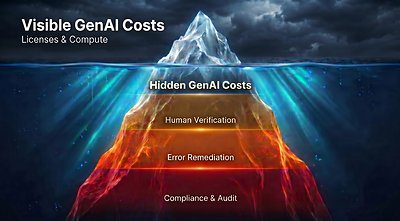
BERKELEY, Calif., May 19, 2026 /PRNewswire/ -- Enterprise AI is running into a problem that many companies did not model during the pilot phase: GenAI is not the only form of AI, and for enterprise decision-making, it is the wrong one to scale. According to Quarrio, the market continues to budget for visible AI costs such as licenses and compute while underestimating the hidden operating burden required to make probabilistic output accurate, auditable, and safe to use in business. That is where the economics of GenAI starts to fail.
"Enterprises were taught to think about AI through the GenAI lens, model capability first, infrastructure second, and trust later," said KG Charles-Harris, CEO of Quarrio. "That is the wrong order for the enterprise. The real cost is not just producing an answer. It is producing an answer the business can depend on. If the answer has to be verified, corrected, governed, and explained before action, then the cost model was wrong from the start."
The Visible AI Bill Is Not the Real One
In its most recent published analysis, available on Quarrio's website, the company argues that the market's biggest mistake is treating the visible compute bill as the real cost of AI. In Quarrio's Decision-Grade AI Cost Model, every $1 spent on visible probabilistic AI compute is associated with roughly $1.86 more in human verification, error remediation, and compliance overhead. That hidden burden is the probabilistic tax, the cost of turning a "probably right" answer into something trustworthy enough to support forecasts, reports, workflows, or business decisions.
According to Quarrio, that misunderstanding remains widespread. AI is often treated as shorthand for ChatGPT, Claude, Gemini, or other probabilistic systems, with the added assumption that AI always requires NVIDIA-scale GPU infrastructure. That view, however, is both technically incomplete and commercially misleading.
Deterministic AI as a Better Enterprise Tool
"Not all AI is GenAI, and that distinction matters much more now than it did a year ago," Charles-Harris added. "For consumer use, a plausible answer may be good enough. For the enterprise, it is not. If the work depends on truth, auditability, and repeatability, then the model has to be built for that. That is why deterministic AI is the better enterprise model, not just because it is more trustworthy, but because it is more cost-effective once AI moves into production."
A probabilistic system generates a statistically likely answer and then leaves the enterprise to determine whether it can be trusted. A deterministic system, by contrast, computes directly against source data and is designed to return the same verified answer to the same question every time. That makes deterministic AI better suited to enterprise environments where accuracy is non-negotiable and where every additional layer of verification adds cost and time delay before the business can act.
That, Quarrio argues, is why deterministic AI is not simply a more governed version of GenAI, but an entirely different operating model altogether. Its architecture runs on standard CPU infrastructure, avoids the GPU dependency and pricing volatility associated with probabilistic systems, and reduces remediation and governance burden through design rather than added process layers. For enterprises that need decision-grade intelligence, the better model is the one that gets a verifiable answer more directly, with less compute, less friction, and less cost.
Numbers Break Down True Costs
In Quarrio's analytical model of current enterprise AI solutions, the hidden burden behind probabilistic AI is not theoretical. For every visible dollar of compute, enterprises can carry another $1.86 in overhead: $0.42 in human verification, $0.61 in error detection and remediation, and $0.83 in compliance and audit costs. These are not one-time implementation expenses, but recurring production costs that grow with usage. The benchmark points out that verification is typically the first hidden cost to surface because every GenAI output must be checked before it can be trusted for business use.
External research points to the same production-stage problem. BCG has reported that only 5% of companies are getting substantial value from GenAI, while 60% report little or no material impact despite significant investment. McKinsey has likewise found that meaningful bottom-line impact from GenAI remains limited, with only 15% of companies reporting a meaningful EBIT effect. Together, these findings support Quarrio's argument that the visible cost of AI is only part of the story, and that the real economic test begins when systems have to deliver reliable value at scale.
"Enterprises can no longer afford to treat GenAI and AI as interchangeable terms," said Charles-Harris. "The model that wins in production will be the one that is accurate, auditable, and economically sustainable at scale. We believe deterministic AI is that model."
About Quarrio
Quarrio is a deterministic enterprise AI platform for mission‑critical decision‑making. It delivers 100% accurate, auditable insights without costly transformation projects and runs efficiently on CPUs and GPUs, optimizing AI infrastructure spend to drive measurable, positive ROI. By cutting information latency from weeks to seconds, it provides instantly available operational intelligence, enabling faster execution and superior competitive outcomes. Led by pioneers behind IBM Watson, Symantec, Machine Intelligence, and major financial platforms, Quarrio is a capital-efficient, high-growth AI company with strong momentum, positioned for disciplined scale in the enterprise market. For more information, visit www.quarrio.com
References
- Apotheker, J., Beauchene, V., de Bellefonds, N., Forth, P., Franke, M. R., Grebe, M., Kataeva, N., Kirvelä, S., Kleine, D., de Laubier, R., Lukic, V., Luther, A., Martin, M., Walters, J., & Schweizer, C. (2025, September 30). The widening AI value gap. Boston Consulting Group. bcg.com/publications/2025/are-you-generating-value-from-ai-the-widening-gap
- Baig, A., Merrill, D., & Sinha, M. (2024, May 13). Moving past gen AI's honeymoon phase: Seven hard truths for CIOs to get from pilot to scale. McKinsey & Company. mckinsey.com/capabilities/tech-and-ai/our-insights/moving-past-gen-ais-honeymoon-phase-seven-hard-truths-for-cios-to-get-from-pilot-to-scale
- Quarrio. (2026, May 5). GenAI doesn't scale the way you budgeted, and the costs are coming due. quarrio.com/news/genai-doesn-t-scale-the-way-you-budgeted-and-the-costs-are-coming-due
MEDIA INQUIRIES
Karla Jo Helms
JOTO PR
727-777-4629
jotopr.com
 View original content to download multimedia:https://www.prnewswire.com/news-releases/not-all-ai-is-genai-quarrio-says-enterprises-are-paying-the-price-for-treating-it-that-way-302776127.html
SOURCE Quarrio

